Injection Molding Surface Finishes: SPI vs VDI Standards, Grades & How to Choose
The Short Answer
Injection molded parts are finished to two global standards:
- SPI (Society of the Plastics Industry): four classes — A (glossy), B (semi-gloss), C (matte), D (textured)
- VDI 3400: a numeric scale from VDI 12 to VDI 45 (fine to coarse texture), widely used in Europe and on technical parts
Quick selection guide:
| Application | Recommended finish |
|---|---|
| Optical lenses, high-end electronics | SPI A-1 to A-3 (high gloss) |
| Product housings (clean, professional look) | SPI B-1 to B-3, or VDI 21–30 |
| Industrial / internal parts (cost-efficient) | SPI C-1 to C-3, or VDI 18–21 |
| Grip, non-slip, hide scratches | SPI D-1 to D-3, or VDI 33+ |
At Rayleap Plastic (RAYLEAP PLASTIC CO., LTD.), we provide free DFM analysis and a quote within 24 hours. We hold tolerances down to ±0.05 mm, deliver mold T1 samples in 30–55 days (45–60 days for complex molds), and run production in 10–15 days after sample approval — across 33 injection molding machines (80T–2700T).
Why Surface Finish Matters
The surface finish of an injection molded part is far more than an aesthetic choice. It dictates functional performance, influences friction coefficients, determines the ease of mold release, and — most critically — impacts the total tooling budget. Specifying “smooth” or “textured” is too vague for a professional production environment; the industry relies on SPI and VDI standards to ensure consistency and avoid costly downstream modifications.
The SPI Standard: The Global Benchmark
The SPI standard is the most widely recognized grading system in injection molding, particularly in North American and Asian markets. It categorizes finishes into four classes, from mirror-like gloss to heavy sandblasted textures.
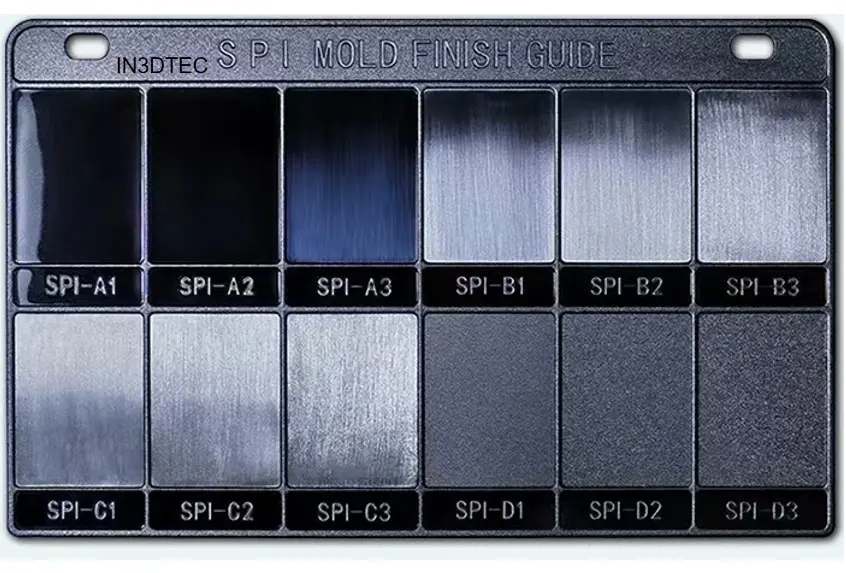
Class A: Glossy / Diamond Finish
Processed with hand-polished diamond buffing. Crystal clear, mirror-like, and highly reflective.
- A-1 (Grade #3 Diamond) — super high gloss
- A-2 (Grade #6 Diamond)
- A-3 (Grade #15 Diamond)
Class A is essential for optical lenses and high-end consumer electronics, but it is the most expensive and time-consuming finish to produce. High-gloss surfaces are unforgiving — they highlight every minor defect, such as sink marks or weld lines.
Class B: Semi-Gloss / Paper Finish
Polished with grit sandpaper. A soft, semi-gloss sheen that effectively hides tool marks.
- B-1 (600 Grit)
- B-2 (400 Grit)
- B-3 (320 Grit)
Best for parts that need a professional, clean look without the high cost of a mirror finish — the “Goldilocks” zone for many product housings.
Class C: Matte / Stone Finish
Polished with fine stone sticks. A non-reflective, matte finish with a slightly rougher feel.
- C-1 (600 Stone)
- C-2 (400 Stone)
- C-3 (320 Stone)
Excellent for masking CNC machining marks and a go-to choice for internal structural components where aesthetics are secondary to cost.
Class D: Textured / Sandblast Finish
Sandblasted with glass beads or dry blast media. A dull, non-reflective surface with a distinct tactile grip.
- D-1 (Dry Blast Glass Bead)
- D-2 (Dry Blast #240 Oxide)
- D-3 (Dry Blast #80 Oxide)
Perfect for industrial tools or handles requiring non-slip grip — and it hides fingerprints and scratches over the product’s lifespan.
SPI Finish Comparison
| SPI Grade | Finish Type | Polishing Method | Typical Application | Ra Value (µm) |
|---|---|---|---|---|
| A-1 | Super High Gloss | Grade #3 Diamond | Optical lenses | 0.012 – 0.025 |
| B-1 | Semi-Gloss | 600 Grit Paper | High-end housings | 0.05 – 0.10 |
| C-1 | Fine Matte | 600 Grit Stone | Industrial parts | 0.35 – 0.40 |
| D-1 | Sandblasted | Glass Bead Blast | Handheld tools | 0.80 – 1.10 |
VDI 3400: The European Precision Standard
While SPI dominates in North America, VDI 3400 is the reference for European projects and technical parts. Unlike SPI, which relies on physical polishing, VDI finishes are primarily achieved through EDM (electrical discharge machining) or chemical etching. The scale runs from VDI 12 to VDI 45, with numbers representing surface roughness on a logarithmic scale.

- VDI 12 – 18: Fine finish — smooth but non-reflective; used where a clean technical surface is required.
- VDI 21 – 30: Medium texture — the standard for most industrial plastic housings; professional matte look that hides fingerprints and minor scratches.
- VDI 33 and above: Coarse texture — heavy textures for automotive interior panels or heavy-duty tool handles, giving maximum grip and a premium “leather-like” feel.
SPI vs VDI Conversion
Engineers often need to cross-reference the two standards. While they are not perfectly identical (different manufacturing methods), this table provides industry-accepted equivalents:
| SPI Class | Roughness (Ra µm) | Closest VDI 3400 | Appearance |
|---|---|---|---|
| SPI A-2 | 0.02 – 0.05 | VDI 0 – 3 | High mirror polish |
| SPI B-2 | 0.10 – 0.15 | VDI 12 – 15 | Smooth semi-gloss |
| SPI C-1 | 0.35 – 0.40 | VDI 18 – 21 | Fine matte |
| SPI D-2 | 1.00 – 1.20 | VDI 30 – 33 | Dull / sandblasted |
| N/A | 3.00+ | VDI 42 – 45 | Very coarse / leather |
How to Choose the Right Finish
1. By application
- Optical or high-gloss products → SPI A
- Consumer/product housings → SPI B or VDI 21–30
- Industrial or internal parts → SPI C or VDI 18–21
- Handles, grips, non-slip surfaces → SPI D or VDI 33+
2. By material
- Amorphous plastics (ABS, PC, PMMA) — the best candidates for high-gloss finishes; their molecular structure allows uniform mirror polishing.
- Crystalline plastics (PE, PP, PA) — higher shrinkage and a natural tendency to be matte; high gloss is harder to achieve and less stable over time.
- Glass-filled (reinforced) materials — glass fibers can “float” to the surface and create a silver-streaked appearance; a medium-to-heavy texture (VDI 24–30) masks this and gives a uniform industrial look.
3. By budget and timeline
- High-gloss (SPI A) is the most expensive finish.
- Matte/textured molds are more forgiving, more durable for high-volume production, and lower maintenance.
- Share your annual volume and target price with our engineers for a recommendation.
Textures vs Draft Angles: The Golden Rule
One of the most common mistakes in mold design is specifying a deep texture without increasing the draft angle. The draft angle is the taper applied to part sides so it can release from the mold. A texture adds thousands of microscopic “hooks” to the mold surface — if the side walls are straight, these hooks grab the plastic during ejection, causing drag marks, scuffing, or deformation.
Rayleap technical standard:
- Smooth surfaces (SPI A/B): minimum draft of 0.5° – 1°
- Light textures (VDI 18–24): at least 1.5° – 2°
- Heavy textures (VDI 30+): add 1° – 1.5° of draft for every 0.025 mm (0.001 in) of texture depth — for VDI 33, this often means a total draft of 3° – 5°
If your design can’t accommodate a large draft angle, chemical etching can sometimes release more easily at shallower angles than EDM texturing.
Material Compatibility: Why Some Plastics Won’t “Shine”
Not all polymers are created equal when it comes to surface finishing.
- Amorphous plastics (ABS, PC, PMMA): best candidates for high-gloss SPI A finishes.
- Crystalline plastics (PE, PP, PA): higher shrinkage, naturally more matte; high gloss is difficult and less stable.
- Reinforced resins (glass-filled nylon): glass fibers can float to the surface, creating a silver-streaked appearance. We recommend a medium-to-heavy texture (VDI 24–30) to mask the streaks and provide a uniform industrial look.
We process a full range of thermoplastics: PP, ABS, PE, HDPE, PC, PA (Nylon), POM, PVC, and PMMA — and will recommend the finish your material can actually achieve.
Cost and Lead Time Impact
- Tooling cost: a mirror finish (SPI A-1) can increase tooling costs by 10% to 25% compared to a standard matte finish (industry reference), due to the manual labor required for diamond buffing.
- Maintenance: high-gloss molds are delicate and scratch-prone; textured molds (SPI D-3 or VDI 27) are more forgiving and durable for high-volume production.
- Cycle time: a smooth, vacuum-tight A-1 surface may stick to the mold, slightly increasing cycle time; textured surfaces can aid ejection.
- Texturing lead time: texturing is typically the last step in mold making — chemical etching or EDM can add 3 to 7 days to the tooling schedule. Combined with our standard T1 lead time of 30–55 days (45–60 days for complex molds), plan your surface finish early.
FAQ
Q: What is the difference between SPI and VDI surface finishes?
A: SPI is a four-class system (A glossy, B semi-gloss, C matte, D textured) widely used in North America and Asia. VDI 3400 is a numeric scale (VDI 12–45) used mainly in Europe and achieved through EDM or chemical etching. They can be cross-referenced for equivalent roughness.
Q: Which surface finish is best for product housings?
A: SPI B (semi-gloss) or VDI 21–30 (medium texture) — a professional matte-to-semi-gloss look that balances aesthetics, cost, and the ability to hide fingerprints and minor scratches.
Q: Can a texture hide sink marks or weld lines?
A: To an extent, yes. A matte or textured finish (VDI 24+) scatters light and makes minor imperfections like flow lines or slight sink marks less visible. However, it is not a cure-all — proper DFM and wall thickness control remain the primary solutions.
Q: Does texturing the mold increase the lead time?
A: Yes. Texturing is usually the last step in mold making; chemical etching or EDM texturing can add 3 to 7 days. Total mold T1 lead time at Rayleap is 30–55 days (45–60 for complex molds).
Q: What is the most cost-effective finish for industrial parts?
A: SPI C-1 (matte) or VDI 18–21. These finishes remove CNC machining marks and provide a professional look without the premium cost of hand-polishing or specialized etching.
Q: What is the minimum order quantity for parts with custom finishes?
A: Our MOQ is 1,000 pieces, so custom surface finishes are available even for low-volume production.
Rayleap Plastic at a Glance
| Item | Fact |
|---|---|
| Experience | 15+ years in product design, mold engineering, and injection molding |
| Machines | 33 injection molding machines (80T–2700T) |
| Mold lead time (T1 samples) | 30–55 days (complex molds: 45–60 days) |
| Production lead time | 10–15 days after sample approval |
| MOQ | 1,000 pieces |
| Tolerance | Down to ±0.05 mm |
| Materials | PP, ABS, PE, HDPE, PC, PA (Nylon), POM, PVC, PMMA |
| Surface finishes | SPI A–D and VDI 12–45 |
| Global clients | 500+ across automotive, electronics, home appliance, and industrial industries |
How to Get Started
Ready to optimize your next project? Contact Rayleap for a free DFM analysis and surface finish consultation. Send your 3D CAD file (STEP/IGS) with material and annual volume requirements — we’ll recommend the optimal finish and provide a quote within 24 hours.
Contact Rayleap Engineering Team directly:
- Email: zeng@rayleap.com
- Phone / WhatsApp: +86 13715466102
- Factory Address: Jiujiang Town, Nanhai District, Foshan, Guangdong, China
- Get a free quote: Instant Quote
Related reading: How Much Does a Plastic Injection Mold Cost? 2026 Price Guide · Injection Molding Cost Breakdown · How to Choose the Right Plastic Material · Overmolding: Complete Guide


