Custom Plastic Enclosures for Electronics
We are a China-based plastic injection molding and mold manufacturing company producing custom plastic enclosures for electronics and other products under one roof. Whether you need electronic housings, home appliance shells, automotive components, or toy casings, our team can support DFM review, mold manufacturing, injection molding, and related tooling processes including CNC machining, EDM, and polishing. With injection molding machines from 80T to 2700T, we can assess a wide range of part sizes and shot weights during project review.
- Mold design, DFM support, and mold manufacturing in one facility
- Injection molding on 80T–2700T machines
- Material selection, CNC, EDM, and polishing services
Request a Custom Enclosure Quote · Contact Our Engineering Team
Custom Plastic Enclosure Manufacturing Capabilities
Rayleap supports the full development of a plastic enclosure, from early design review to finished, molded parts. Because tooling and molding are handled within the same workflow, design choices can be checked against manufacturability before steel is cut, which helps reduce rework and keeps the project moving in one direction.

Custom plastic enclosure projects may be suitable for applications such as:
- Consumer electronics: device housings, remote controls, routers, and other handheld or connected products
- Home appliances: control panels, covers, and structural shells
- Automotive components: interior and functional plastic parts
- Toys and consumer products: casings and enclosures
Every project begins with a review of geometry, material, and expected volume. This review shapes the tooling and production approach, so the quotation reflects the actual requirements of the part rather than a one-size-fits-all estimate. If your product must meet specific environmental or mechanical conditions, share those early so the design review accounts for them.
From Design to Production: Our One-Stop Process
The path from a concept to a molded enclosure moves through several connected stages. Because design, tooling, and production sit in one place, information moves forward without being reinterpreted between suppliers.
Design and DFM Support
We start with your CAD file or drawings and review the part for manufacturability. Our engineers examine wall thickness, draft, rib and boss placement, and parting line location, then return practical feedback that can be applied before tooling begins. This stage can help identify design issues that may otherwise lead to tooling revisions, extra development work, or delays later in the project.
Mold Design and Mold Manufacturing
Once the design is confirmed, the mold is designed around your part and built in our facility. The work includes CNC machining, EDM, and polishing to produce the core and cavity details the enclosure requires.
Injection Molding and Finishing
After the mold is approved, parts are molded on our injection molding machines. Processing parameters are set for the selected material, and finishing steps such as polishing are applied as the product requires. Surface, color, texture, printing, and assembly requirements should be discussed during quotation, as available options depend on the material, tooling plan, and project specifications.
DFM Design Guidelines for Plastic Enclosures
Good enclosure design starts with manufacturability. The following are general references; our design and engineering team reviews each part individually and provides feedback specific to your geometry.
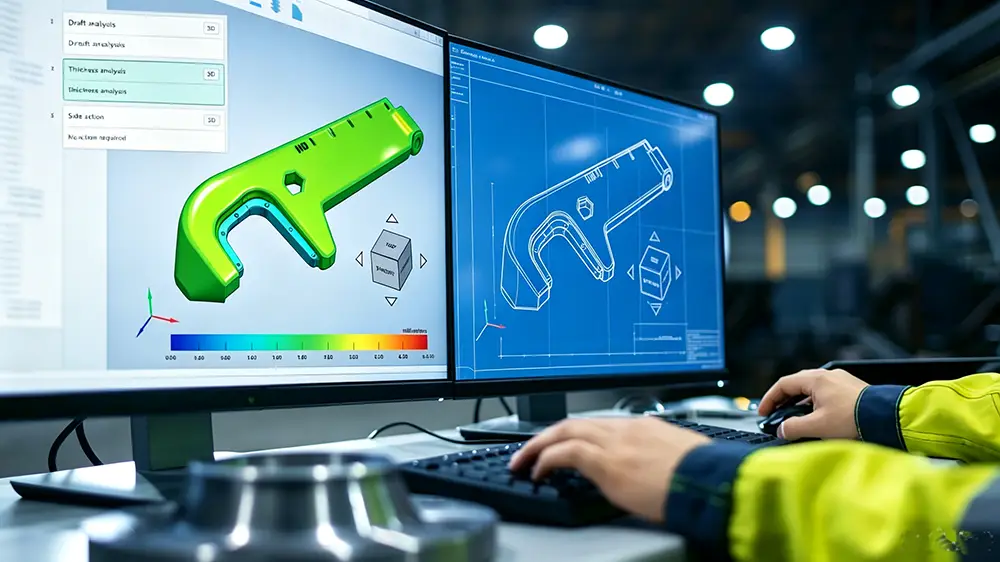
Wall Thickness
Uniform wall thickness helps parts fill evenly and cool consistently. Abrupt changes in thickness can lead to sink marks, warpage, or internal stress. Where possible, ribs and bosses should be kept thinner than the main wall to avoid creating heavy sections.
Draft Angle
Draft is a slight taper applied to vertical faces so the part ejects cleanly from the mold. Adding draft to enclosure walls and deep features reduces ejection marks and supports reliable cycling.
Ribs, Bosses, and Snap Fits
Ribs add stiffness without increasing wall thickness. Bosses create attachment points for screws or inserts. Snap fits can reduce fastener count, but their geometry must be designed so the feature flexes without cracking over repeated use.
Parting Line and Gate Location
The parting line is where the two mold halves meet, and the gate is where molten plastic enters the cavity. Both influence appearance and function. We position the gate and parting line to minimize visible marks on cosmetic surfaces where the design allows.
For precision features, we can hold tolerances as tight as ±0.05 mm where design and material allow. Final tolerances are subject to tooling review.
Materials for Custom Plastic Enclosures
Material choice affects strength, heat resistance, appearance, and cost. The materials below are common for plastic enclosures; final selection depends on the application, environment, and design requirements.
ABS
ABS offers good impact resistance and a smooth surface finish. It is a frequent choice for consumer electronics housings and general-purpose enclosures that do not require high heat or chemical exposure.
PC (Polycarbonate)
Polycarbonate provides high impact strength and clarity, with better heat resistance than ABS. It suits enclosures that need toughness or transparent sections for lenses and indicators.
PC/ABS
PC/ABS balances the impact strength of polycarbonate with the processability and finish of ABS. It is widely used for electronics housings where a combination of toughness and surface quality is required.
PP (Polypropylene)
Polypropylene is lightweight and offers good chemical resistance. It is often selected where flexibility, living hinges, or exposure to chemicals are part of the design.
PA (Nylon)
Nylon provides strength, wear resistance, and stable performance at elevated temperatures. It is used for enclosures and internal components that carry mechanical load or experience friction.
POM (Acetal)
POM offers high stiffness, low friction, and good dimensional stability. It is a practical option for precision moving parts inside an enclosure, such as gears and latches.
Material selection is confirmed during the DFM stage, where the material is matched to the part geometry and its intended use.
Tooling and Injection Molding Capabilities
Rayleap provides both tooling and production. Our mold manufacturing covers mold design, CNC machining, EDM, and polishing, while our injection molding machines range from 80T to 2700T to accommodate different part sizes and shot weights.

Developing the mold and the molding process together means decisions such as gate style, runner type, and cavity count are made with the production plan in mind. This helps support efficient cycles and consistent parts across the run.
What to Send for a Custom Enclosure Quote
To prepare an accurate quotation, we typically ask for the following:
- 3D CAD file (STEP or similar), if available
- 2D drawings with key dimensions and tolerances
- Material preference or application requirements
- Estimated quantity or production plan
- Required surface finish or color
- Operating environment or any special requirements
If you do not yet have a production-ready design, we can discuss 3D printing for prototyping, or work with you to refine the concept before tooling.
Frequently Asked Questions
What design files do you accept?
We can work from 3D CAD files such as STEP, together with 2D drawings. If your design is still at an early stage, we can review sketches or a product brief and advise on the next steps.
Can you help choose the right material?
Yes. During DFM review we discuss options such as ABS, PC, PC/ABS, PP, PA, and POM, and recommend a material based on the application, environment, and mechanical requirements.
Can I make a prototype before committing to production tooling?
Yes. Prototyping can help validate fit and function before mold manufacturing begins. The right route depends on your timeline, design, and how closely the prototype must match the final molded part.
Do you support both small and large quantities?
We can discuss your quantity during the quoting stage. The most suitable production approach depends on the part design and your volume, and we will recommend an option that fits your project.
What finishing options are available?
Surface finish specifications, texture requirements, polishing, color, printing, or assembly needs should be confirmed during quotation, based on the material, tooling plan, and intended appearance of the enclosure.
Request Your Custom Enclosure Quote
Send us your CAD file, drawings, or a product brief, and our engineering team will review your design for manufacturability and respond with a quotation.
Request a Custom Enclosure Quote


